


What Is UGC Conversion Rate and What's a Good Benchmark for Beauty Brands?

Beautytap Admin
Jul 5, 2026
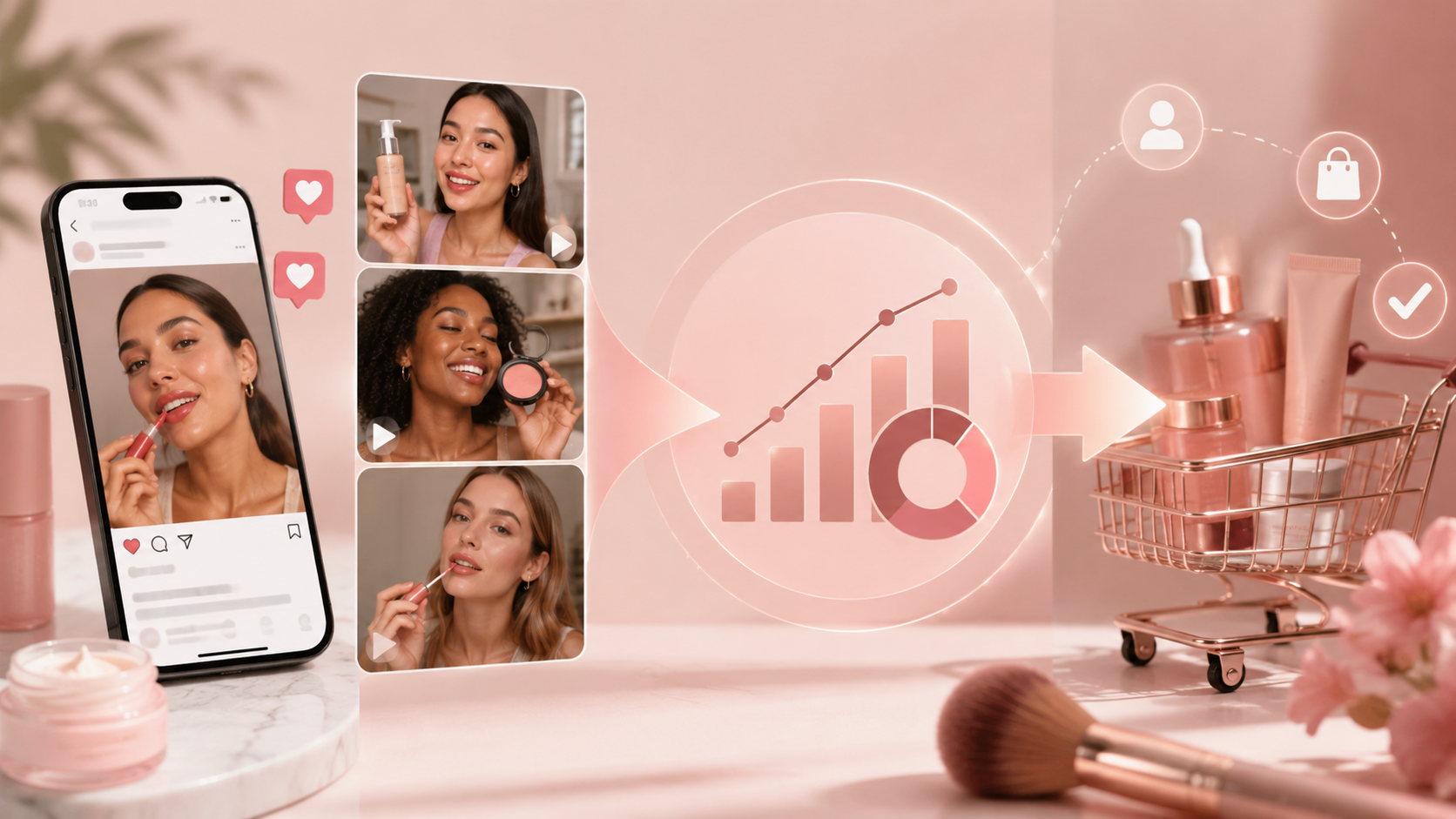
If you're a beauty brand running UGC in your marketing and not tracking conversion rate as a distinct metric, you're missing the most important signal your content is sending you.
UGC conversion rate measures how effectively user-generated content — reviews, skincare tutorials, makeup try-ons, unboxings, creator posts — moves a beauty shopper to take a desired action. That action could be a purchase, an add-to-cart, a click-through from an ad, or a product page visit. The specific definition depends on where the UGC is deployed and what "converting" means at that stage of your funnel.
The reason this metric matters in beauty specifically is that purchase decisions in this category are heavily sensory and trust-driven. A consumer can't feel a moisturizer's texture, smell a fragrance, or see how a foundation shade adapts to their skin tone through a product shot alone. UGC bridges that gap. And whether it's actually doing that job is what conversion rate tells you.
Why UGC Conversion Rate Is Tracked Differently by Channel
UGC in beauty doesn't live in one place. A skin-tint tutorial on TikTok is a different asset serving a different function than a verified review on a Sephora PDP or a before-and-after photo in a retargeting ad. Each channel has its own conversion metric.
On PDPs, UGC conversion rate measures how many visitors who interact with reviews, creator photos, or embedded video go on to purchase. In beauty, this is particularly meaningful because shoppers often read reviews looking for people with similar skin types, concerns, or tones. A consumer with acne-prone skin scanning reviews for mentions of breakouts is doing targeted research — and a review that speaks to her directly will convert her better than any brand copy can.
In paid ads, UGC conversion rate tracks CTR and downstream purchase conversion relative to studio creative. Beauty UGC ads — a creator showing their real skin before and after a serum, an honest mascara application, a genuine "this is what it actually looks like on me" moment — routinely outperform polished campaign content because beauty consumers have learned to distrust aspirational imagery.
In email, UGC conversion rate tracks how beauty shoppers who engage with embedded reviews or creator content convert compared to those who receive promotion-only emails.
What's a Good Benchmark for Beauty?
Benchmarks vary, but here are directional figures specific to the beauty category:
- Visual UGC on beauty PDPs — real photos showing skin results, product texture, or color payoff — can lift conversion rates significantly over brand-only imagery. Shoppers want to see how a blush looks on deeper skin tones or how a moisturizer sits under makeup. Stock imagery doesn't answer that question.
- UGC video ads featuring real beauty routines and honest product reactions consistently outperform traditional creative in CTR, with the performance gap widest in skincare, where skepticism about claims is highest.
- Reviews that include photos convert at higher rates than text-only reviews in beauty specifically, because application and results are visual. A written review that says "great coverage" carries less weight than one accompanied by a photo showing it.
The caveat: your category within beauty matters. Skincare, haircare, color cosmetics, and fragrance all have different consumer behavior patterns and trust triggers. A benchmark for foundation may not apply to a hair mask. Build your own baseline and measure lift over time.
The Most Common Reason Beauty UGC Conversion Rates Underperform
The content isn't the problem. The activation is.
Beauty brands are often sitting on incredibly valuable UGC — genuine reviews from consumers who saw real results, creator videos showing real skin transformations, photos that capture how a product actually performs — and deploying it in ways that disconnect it from the moment of decision. Reviews are buried below the fold on PDPs while polished campaign imagery dominates above it. UGC video lives only on social but never makes it to the product page. Creator content runs as an ad but the landing page has no supporting social proof.
Beauty consumers are sophisticated. They can tell when a brand's marketing is aspirational versus when real people are backing it up. When UGC is siloed instead of integrated, that gap is visible — and it creates friction at exactly the moment you need trust most.
How to Start Improving Your Beauty UGC Conversion Rate
Audit where your UGC actually lives versus where your shoppers are making decisions. If your best-performing creator skincare video is only on Instagram but not embedded on your serum PDP, that's a missed conversion. If your reviews aren't informing your ad copy, you're writing from brand assumptions instead of the language real beauty consumers use to describe your products.
Then track conversion rate by content type, placement, and audience. Over time you'll see which combinations drive the most consistent lift — and that data becomes the brief for your next UGC program, grounded in evidence rather than intuition.
UGC conversion rate isn't just a metric. It's a diagnostic tool that tells you whether your content is actually doing the job you need it to do.
Want more views into sales? Learn how to measure UGC conversion rates, benchmark your performance, and optimize every campaign for better results. Contact Us Now!