


Why Do Beauty Expert Reviews Outperform Standard Consumer UGC?

Cliff Beach
Apr 16, 2026
The Question Behind the Performance Gap
One of the most common questions I get from brands is simple on the surface but complex underneath: why do beauty expert reviews consistently outperform standard consumer UGC? Most people assume it comes down to credibility or authority, and while that plays a role, it’s not the full picture. The real reason expert reviews outperform is because they are structured, trained, and designed to convert, not just to express an opinion. At Beautytap, we’ve seen this play out across campaigns, categories, and retailers. The difference is not just who is speaking, but how they are taught to communicate.
The Problem with Standard Consumer UGC
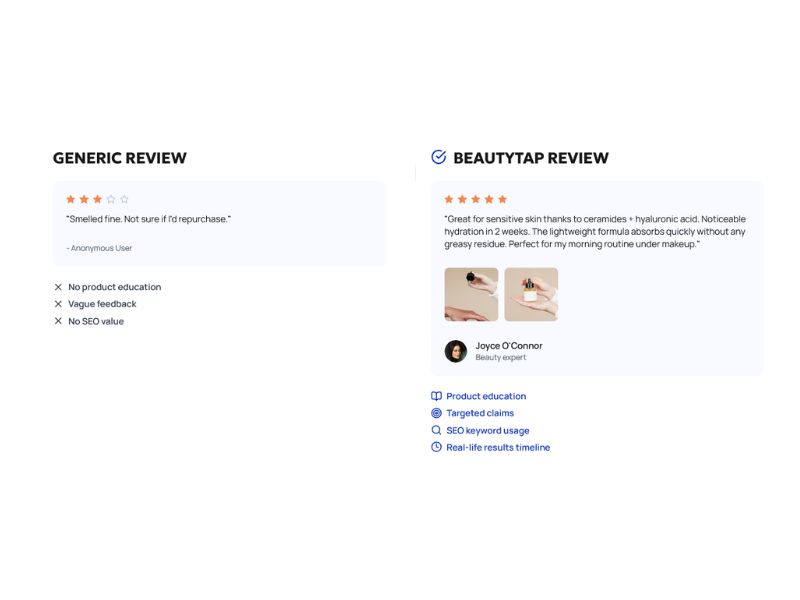
Standard consumer UGC is valuable, but it is inconsistent by nature. Most consumer reviews are short, reactive, and lack depth. They often look like this: “I loved this product, it worked great,” or “Not for me.” While those statements provide a signal, they don’t provide enough context for a potential buyer to make a confident decision. There is usually no explanation of how the product was used, what specific benefits were experienced, or who the product is actually best for. From a buyer’s perspective, this creates friction. From a brand’s perspective, it limits conversion.
The issue is not authenticity. Consumers trust other consumers. The issue is information density and usefulness. If a review doesn’t answer the questions a buyer is already asking in their head, it doesn’t move them closer to purchase. It just adds noise.
What Makes a Beauty Expert Review Different
The core difference with expert reviews is not just expertise. It is structure, training, and intentionality. At Beautytap, we don’t simply rely on someone’s background or following. We vet our community of beauty enthusiasts, content creators, and licensed professionals, and then we train them. That training includes written education, on-demand modules, and live sessions on Zoom with both our in-house educator and the brand’s educator. This ensures that creators are not only familiar with the product, but also understand how to communicate about it effectively.
Before participating in campaigns, creators must also submit a test review. This review must meet a minimum character requirement and follow what we call the anatomy of a high-performing review. This is where the real difference begins to show.
The Anatomy of a High-Performing Review
We teach our community to structure reviews around three core components: functional use and benefit, sensorial experience, and recommendation. This framework transforms a review from a casual opinion into a conversion tool.
The first component is functional use and benefit. This is where the reviewer explains how the product served its intended purpose and what specific results they experienced. Instead of saying “this moisturizer is great,” a trained reviewer might explain how it improved hydration levels, how it performed under makeup, or how it supported a particular skin concern. This level of detail allows the reader to map the product onto their own needs.
The second component is sensorial experience. Beauty is inherently sensory, and this is often missing in standard consumer reviews. We train creators to describe texture, scent, absorption, and even emotional response. Does the product feel lightweight or rich? Does it have a calming scent? Does it create a spa-like experience or a clinical one? These details help bring the product to life for the reader and reduce uncertainty.
The third component is recommendation. This is where the reviewer clarifies who the product is best for. Is it ideal for dry skin, oily skin, sensitive skin, or combination skin? Is it better for beginners or advanced routines? This guidance is critical because it helps the buyer self-qualify. Instead of guessing, they can quickly determine if the product fits their profile.
Why Structure Drives Conversion
When you combine these three elements, you get a review that answers the three most important questions every beauty consumer has: does it work, what does it feel like, and is it right for me. Standard consumer UGC rarely answers all three. Expert reviews consistently do.
This is why structure matters more than volume. You can have hundreds of short, vague reviews, but they won’t outperform a smaller set of detailed, well-structured reviews that actually guide decision-making. In many cases, one high-quality expert review can do the work of multiple generic ones because it removes friction from the buying process.
The Power of Depth: Why Length Matters
Another key difference is length. At Beautytap, our reviews require a minimum of 500 characters, and in practice, many exceed that. This means our reviews are often double the length of standard consumer reviews. That additional space is not filler. It is where the value lives.
Longer reviews allow for storytelling, context, and specificity. They give the reviewer room to explain how they incorporated the product into their routine, what changes they observed over time, and how it compares to other products they’ve used. This creates a richer, more informative experience for the reader and builds trust.
From a conversion standpoint, more information reduces hesitation. When buyers feel informed, they are more confident. When they are more confident, they are more likely to purchase.
Education Is the Multiplier
One of the biggest reasons expert reviews outperform is education. We don’t assume creators know how to write a high-performing review. We teach them. Through a combination of written materials, on-demand learning, and live sessions with educators, we ensure that every participant understands both the product and the expectations.
This education creates consistency. It ensures that regardless of who is reviewing the product, there is a baseline level of quality and depth. It also allows brands to communicate key product details accurately without scripting the content. The result is content that is both informed and authentic.
Balancing Authenticity and Accuracy
A common concern brands have is that training might reduce authenticity. In reality, the opposite is true. Training gives creators the tools to express their authentic experience more clearly. It does not tell them what to say. It helps them say what they experienced in a way that is useful to others.
This balance between authenticity and accuracy is where expert reviews outperform. Standard consumer UGC may be authentic, but it is often incomplete. Traditional branded content may be accurate, but it can feel overly polished. Expert reviews sit in the middle. They are informed, structured, and still personal.
Visual UGC + Written Depth = Stronger Impact
Another factor that drives performance is the combination of visual and written content. At Beautytap, reviews often include UGC imagery alongside detailed written feedback. This pairing is powerful. The visuals provide immediate context and credibility, while the written review delivers depth and explanation.
Many standard consumer reviews rely heavily on visuals or short captions. While that can drive engagement, it does not always drive conversion. When you combine visuals with structured, informative writing, you create a more complete experience that supports both discovery and decision-making.
Helping Buyers Make Faster Decisions
At the end of the day, the goal of any review is to help a buyer decide. The faster and more confidently they can make that decision, the better the performance. Expert reviews accelerate this process because they remove ambiguity.
Instead of leaving the buyer to interpret vague statements, expert reviews guide them. They explain how the product works, what it feels like, and who it is for. This clarity shortens the decision cycle and increases the likelihood of conversion.
Why Brands Benefit from Objectivity
Another advantage of working with a trained community is objectivity. Brands are often too close to their own products to evaluate content effectively. They may focus on brand voice, aesthetics, or messaging preferences that don’t necessarily align with what consumers respond to.
A third-party platform like Beautytap introduces a layer of objectivity. We help brands focus on what actually drives performance rather than what feels subjectively right. This includes guiding them on how to interpret reviews, what to look for in high-performing content, and how to leverage that content across channels.
The Compounding Effect Over Time
Like all UGC, expert reviews perform best when approached as a system rather than a one-off campaign. Over time, brands build a library of high-quality, structured reviews that can be used across PDPs, retailer sites, and marketing channels. Each review adds to the overall information ecosystem, making it easier for future buyers to convert.
As more reviews accumulate, patterns emerge. Brands begin to understand which messages resonate, which benefits matter most, and which audiences respond best. This learning compounds, making each subsequent campaign more effective.
Final Thought: It’s Not Just Who, It’s How
So why do beauty expert reviews outperform standard consumer UGC? It’s not just because of who is writing them. It’s because of how they are trained, structured, and delivered. Expert reviews are designed to inform, guide, and convert. They answer the questions that matter and provide the depth buyers need to feel confident.
In a category like beauty, where experience is everything and trust is critical, that difference is not small. It is the difference between content that gets noticed and content that actually drives action.